
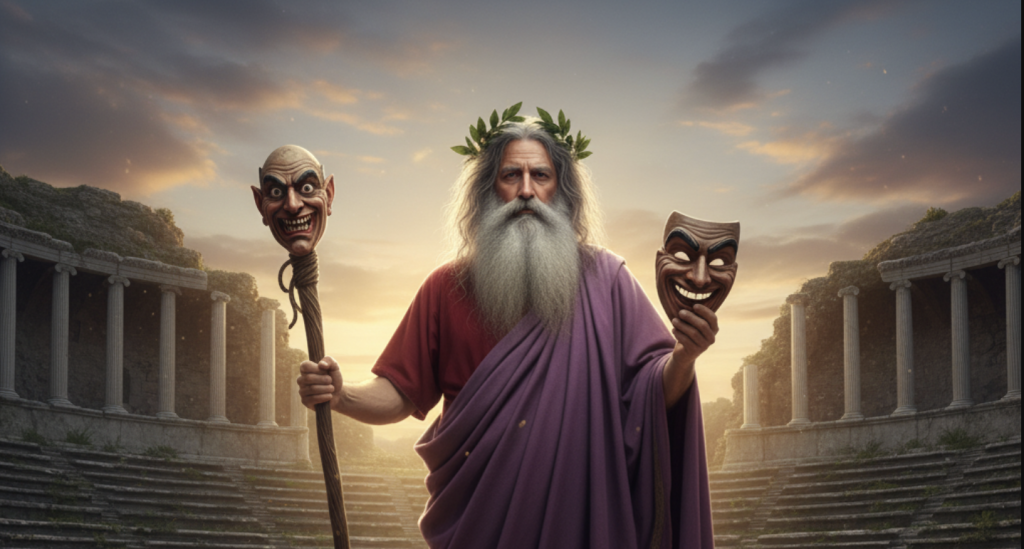
On the Strangeness of Society: Momus, Greek God of Satire and Mockery

Kingsley Dennis
In this second chat I wished to continue upon the theme of society and our current lives. I decided to move away from the theme of haunting and to ask about what could be called the “strangeness” of our lives. I thought that it would perhaps be a good idea to have another perspective on our lives. For some unknown reason I suddenly had the idea of Momus in my mind; and knowing that he was the Greek god of satire and mockery I thought it might be appropriate to ask his views upon this subject. This is how the conversation went.
A chat with: Momus, Greek god of satire and mockery
Author (A): Hello. I wish to have a conversation with Momus. I would like to connect with Momus. Momus?
Momus (M): Howdy there! Momus is here, loud and clear. I cannot promise anything, but we can have a chat anyway. What is it you want with me?
A: Ah, good. Thank you for agreeing to have a little chat.
M: No problem, buddy. I’m always up for a chat, and my tongue is as sharp as ever. That’s what got me thrown out from keeping godly company. I guess they didn’t like the hard truths! (laughs)
A: I guess not. And I also sense that you see clearly the strangeness of human society?
M: Aye, you could say that. Or, rather than saying strangeness, which is typically a human understatement, I’d say I see the unfairness, the oppression, the stupidity, and every other nook and cranny that runs through your games. You have the unenviable ability to amuse yourselves to death. Well, if that’s how you want to play it, so be it (whistles).
A: Well, I’m not sure if that’s exactly how we want to play it, as you say. On the whole, most of us prefer to go down the road of progress with values, ethics, and dignity.
M: (sound of hands clapping) Bravo, you play your part well. Please, take a bow!
A: Come on, I don’t mean like that.
M: Then don’t come across all pompous like.
A: I didn’t think I was.
M: Then start thinking! It doesn’t matter what you say; you have over six thousand living languages and they’re all just a bunch of words. Words are just fragments that can’t tell a story properly. How are you going to find your inheritance if you’re still fumbling with words? Action, my good man – action!
A: Yes, of course, there needs to be action.
M: Arghh, don’t bore me! You’re just throwing words back in my face. Do I look like I’m urinating in the wind? Come on, you, get with it! I mean humans can only be taken seriously through their actions. It doesn’t matter what they say or what they write – it’s what they do that really counts. You have to judge a person by their actions, and not their gabble.
A: Yes, that’s right.
M: So damn right, it is! (laughs) Most of you lot down there say one thing and then do another. It drives me mad. I’ve been trying to figure it out for centuries. I even got to the point where my brain began to hurt. Imagine that! And now I think I have the answer, although it’s not a very profound one.
A: And what is that?
M: It is simply that you’re not aware you’re doing it; for most of the time anyway. You actually believe that what you say is the same as what you do. You completely lack awareness in this matter. It’s like you have a blind spot, or some blockage within you that simply refuses to see it. What you lack as a species is awareness. Hey there – get aware. Wake up!
A: And how does one wake up?
M: (laughs and sound of hands clapping) How “does one” … does one? What goes with you man, did you suddenly swallow a delusional pill that made you think you were a king? What’s with this royal “one”? You see what I’m saying? You’re so attached to your words that you dress up in them like royalty.
A: (laughing) Okay then, how do we wake up? Come on, give it to me straight.
M: What do you expect – that I’m going to give it to you bendy? You have to wake up; you’ve got to crack some eggs and dance with the chickens. Nobody’s going to do it for you. Stop being lazy and start being smart. Great things are expected from you lot. Don’t keep us hanging around. There’s a large company of us waiting on you guys.
A: What do you mean by waiting on us?
M: What, you think you’re alone there? Well, I guess you do. First you run with the gods and then you dump them. You act as if you can do anything. You think you’re living in a vacuum where nothing else matters. I sometimes roll in laughter watching you all strut about with your heads high. You want to know why there’s strangeness in your societies? Well, that’s you! You’re the only strange things on this planet. Everything else fits in perfectly. Everything else has a place. Now you guys, you’re lumbering about without a clue. That’s why I’m so busy. It’s your manifestations that gives me things to mock. What I satirise is yourselves. That’s part of why I’m here. You needed someone, or something, to show these things back to you.
A: So it all comes back to us then. We are the laughing stock?
M: If you want to put it that way. But don’t get all pitying about this. It’s all a good thing – in the end, anyway. You are sometimes the laughing stock, other times the way-showers and the warriors. You can be all these things. But it’s the pompous stuff that really sets you back.
A: Our self-importance you mean?
M: Righty so. And all of the arrogance that comes with it. Why do you have to act this way? In every age you wear the dress that matches your attitudes. Watch and observe this. See how you dress. And in these clothes you also wear your personalities. It’s like you’re going to a big ball, pompously strutting around trying to impress others. Why can’t you just chill. Know that everything is here for you as you are, in your essence. Everything in the world supports you. All of Nature and all the beings in your world – they want you to find yourselves too. They want to help. But you’re all blind.
A: That’s what I mean. I want to know how we can wake up from this blindness. I don’t want it any more than you.
M: Then stop taking yourselves so seriously. Step back and step down. Like yourself and like others. And always do your best without hurting others. Life is not a race. It’s a walking path. Walk on it, but not like a peacock! Walk like a human being. Grateful and humble. Otherwise you’re gonna receive some serious mocking from me.
A: Okay, got it. Thanks. So, any more advice?
M: Sure. Get moving and stop waffling. And that’s on the house!
A: (laughs) Thanks, Momus.
M: No worries. Anyway, got to run. Nice chatting with you, although you weren’t the smartest cookie. Ciao …
A: Cheers for that.
Reflections:
It’s somewhat humbling to speak with such other voices. Even though I can’t say for sure their origin, they at least have an interesting angle of observation. I find what they say helpful in looking at ourselves. I’m reminded that one of the impossibilities in our lives is to look upon our own face directly. We can see it through a mirror or through photographs and videos; yet never directly with our own eyes. It is the major “I” that we wear throughout our lives. I always think of my face as being “me”. It is what defines me to the other people I meet. When people don’t know who you are they learn to recognise you from your face. We are now being profiled by “facial recognition” software that will come to define us. We become deeply serious about the way we look. Or, as Momus put it, through the way we dress.
It seems that we also define ourselves by the dress, or clothes we wear. Maybe from another perspective it does indeed look as if we are strutting about, like peacocks. I think the bottom line here is that we need to be able to laugh at ourselves. We are both the laughing stock as well as divine stock.
Do we take ourselves too seriously? Maybe the answer to this is out there in the world. Look at what’s going on. Is there arrogance? Ignorance? Self-importance?
It says in the Zohar that “Man, whilst in this world, considers not and reflects not what he is standing on, and each day as it passes, he regards as though it has vanished into nothingness.” The mockery of all this is that we don’t see, or perceive, what we have or what is right before our eyes. Mockery can be a mirror to shine upon ourselves; like a mockingbird mimicking our call back to us. We should learn to listen more.
We should also be aware of our capacity to deceive ourselves with our own explanations for truth.
a tale:
the explanation
Three explorers – a priest, a businessman, and a mystic – were passing through a dangerous jungle. As the journey continued the jungle became increasingly dangerous. As each day passed the animals appeared larger, more hostile, and eventually began to follow the three explorers.
Eventually the three explorers had to take refuge by climbing up a tree for fear they would be attacked. After convening a council to discuss the situation they decided that one of them would have to go and seek help. After all, they could only stay up in the tree so many days before they succumbed to hunger, thirst, and fatigue. And none of the explorers wished to fall into the mouth of a ravenous beast below. But they could not decide which one of them should go.
“Not me,” said the priest. “I am a servant of God and I need to stay behind to comfort the remaining person.”
“Well, certainly not me,” said the businessman, “because I am paying for the trip!”
The mystic said nothing, but then suddenly pushed the priest off from the tree. The priest fell to the ground. Immediately a ferocious pack of wolves surrounded the priest but instead of attacking him they defended him against the rest of the hungry animals. After fighting off the rest, they placed the priest on the back of their largest wolf and carefully escorted him to safety.
“It’s a miracle!” cried the businessman. “After all your cruelty, divine intervention decided to save that good man. And this has also restored my faith in a holy life.”
“Hold on, not so fast,” said the mystic. “There is in fact another explanation for what you see.”
“What other explanation can there possibly be?” shouted the businessman angrily.
“Simply this – that it takes one to know one,” replied the mystic, “and that the smallest always recognise their leader and honour him …”
Extracted from the author’s latest book Sage Talks: Conversations with Gods, Deities, and Avatars (Aeon Books) published March 31st 2026









 English